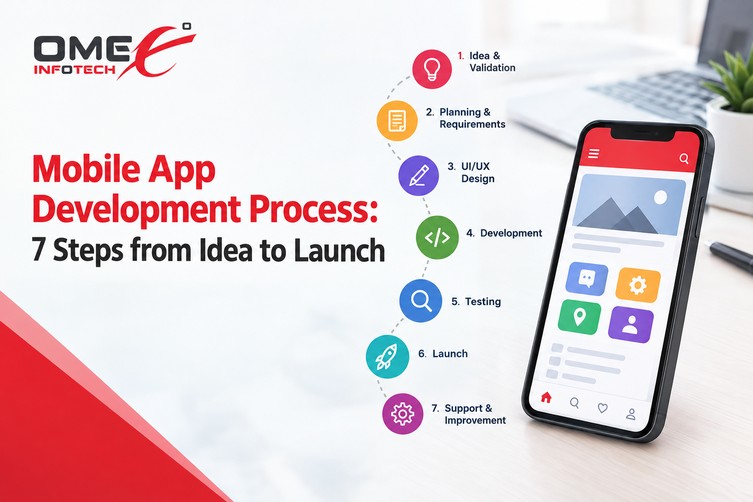
Mobile App Development Process: 7 Steps from Idea to Launch
A successful mobile application starts with a clear business objective, a practical plan, and an understanding of what users actually need. The Mobile App Development Process helps businesses transform an initial idea into a functional, user-friendly, and scalable digital product. Whether you are a startup building your first application or an established company improving customer experiences, following a structured approach can reduce development risks, control costs, and support long-term growth.
From validating an idea to releasing an application on app stores, every stage plays an important role in product quality and user satisfaction. Here are seven essential steps businesses should understand before starting a mobile app project.
1. Define Your App Idea and Validate Market Demand
The first step is identifying the problem your application will solve. Instead of immediately listing features, determine who your users are, what challenges they face, and how your app can provide a better solution.
Research your target audience, study competing applications, and identify gaps in existing solutions. Customer interviews, surveys, competitor reviews, and simple prototypes can help you validate whether people are likely to use your product.
For example, a retail business may develop an app to simplify repeat purchases, while a logistics company may need real-time shipment tracking. Clearly defining the business problem gives the development team a practical direction.
2. Plan Features, Requirements, and Budget
Once the idea is validated, convert it into a development plan. Define the essential features, technical requirements, expected timeline, budget, and measurable business objectives.
Start with a Minimum Viable Product (MVP), which includes the core functionality required to deliver value to early users. Additional features can be introduced after collecting feedback and understanding actual usage patterns.
Typical requirements may include user registration, payment integration, product search, push notifications, reporting dashboards, and third-party API connections. Prioritize these according to business value rather than attempting to include everything in the first release.
A detailed scope document also helps prevent unnecessary changes during development and makes project estimates more realistic.
3. Design an Intuitive UI and UX
User interface (UI) and user experience (UX) design determine how people interact with your application. A visually appealing app must also be easy to navigate, accessible, and efficient to use.
Designers typically create wireframes, screen layouts, interactive prototypes, and visual design systems before development begins. These deliverables help stakeholders understand the proposed experience and identify usability problems early.
Focus on clear navigation, readable typography, consistent buttons, appropriate spacing, and helpful error messages. Test prototypes with representative users to discover confusing steps before they become expensive development changes.
A strong design process improves usability and helps establish a consistent experience across different devices and screen sizes.
4. Choose the Right Technology and Development Team
Technology decisions influence application performance, maintenance requirements, scalability, and development costs. Businesses must decide whether to build separate native applications for iOS and Android or adopt a shared-code approach.
Cross platform app development can help businesses deliver applications across multiple operating systems while reusing significant portions of the codebase. Native development may be more suitable when a project depends heavily on platform-specific functionality or specialized performance requirements.
The right choice depends on your feature requirements, available budget, expected user base, integrations, and long-term roadmap.
Partnering with an experienced mobile app development company can help you evaluate these options. Look for a team with relevant project experience, transparent communication, quality assurance practices, and a clear approach to security and maintenance.
5. Develop the Application and Integrate Essential Features
During development, the team turns approved designs and requirements into a working application. This may include mobile interfaces, backend services, databases, APIs, authentication, payment systems, and administrative tools.
Developers commonly divide work into smaller iterations, allowing stakeholders to review progress and provide feedback regularly. Frequent demonstrations help identify misunderstandings before they affect major portions of the project.
Businesses seeking tailored functionality may benefit from custom mobile app development services, particularly when standard templates cannot support their workflows, integrations, or security requirements.
Maintain readable code, document important technical decisions, and protect sensitive information throughout development. Security measures should include appropriate access controls, secure communications, and careful handling of user data.
6. Test the App Before Launch
Testing verifies that the application works as expected under realistic conditions. It should begin during development rather than being postponed until the entire product is complete.
The quality assurance process should cover:
- Functional testing: Confirms that features and workflows operate correctly.
- Usability testing: Checks whether users can navigate the app easily.
- Compatibility testing: Evaluates performance across supported devices and operating system versions.
- Performance testing: Identifies slow screens, crashes, and resource problems.
- Security testing: Looks for vulnerabilities and weaknesses in data protection.
- Integration testing: Verifies that APIs, payment gateways, and connected systems work together.
Also test unreliable internet connections, interrupted transactions, permission settings, and unusual user inputs. Resolve critical issues before release and confirm that important user journeys work consistently.
7. Launch, Monitor, and Improve Your App
Before launch, prepare your app store listing, screenshots, description, privacy disclosures, and other required submission information. Follow the current Apple App Store and Google Play requirements, and allow time for platform review.
However, publishing the app is not the end of the Mobile App Development Process. After release, monitor crashes, performance, downloads, retention, user feedback, and completion of important actions.
Use analytics to understand which features users value and where they encounter difficulties. Regular updates can improve usability, strengthen security, resolve bugs, and introduce features based on real demand.
If you plan to hire mobile app developers, discuss post-launch support, operating system updates, monitoring, and future enhancements before the project begins. Ongoing maintenance helps keep the application reliable as technology and customer expectations evolve.
Conclusion
A successful mobile application requires more than good coding. It depends on validating the idea, defining requirements, designing for users, selecting appropriate technology, developing securely, testing thoroughly, and continuously improving after launch. Following these seven steps gives businesses a clearer path from concept to release while reducing avoidable risks.
If you are planning a new application or upgrading an existing product, Omex Infotech can help you explore the right approach for your requirements. Visit our mobile app development services page to discuss your project, evaluate development options, and take the next step toward building an application that supports your business goals.
FAQs
The mobile app development process is the structured approach used to plan, design, build, test, launch, and maintain a mobile application. It typically includes idea validation, requirements planning, UI/UX design, development, quality assurance, deployment, and ongoing improvements.
The seven steps are idea validation, requirements and budget planning, UI/UX design, technology and team selection, application development, testing, and launch with post-release improvement.
The timeline depends on the app’s complexity, features, integrations, platform requirements, and team size. A simple application may take a few months, while a complex enterprise solution can require considerably longer.
Costs vary according to project scope, design requirements, technology, security needs, integrations, and ongoing support. A detailed requirements assessment is the best way to obtain a realistic estimate.
A Minimum Viable Product is an initial version containing the essential features needed to solve the primary user problem. It allows businesses to gather feedback and validate demand before investing in additional functionality.
Native development is useful when an app requires extensive platform-specific functionality. Cross-platform development can reduce duplicated work when building for iOS and Android. The best choice depends on technical requirements, budget, performance expectations, and maintenance plans.
An experienced development company can provide coordinated expertise in planning, design, programming, testing, deployment, and maintenance. It can also help identify technical risks and select an approach suited to your business goals.
Custom mobile app development services involve designing and building applications around a business’s specific requirements, workflows, branding, integrations, and user needs rather than relying entirely on a standard off-the-shelf solution.
Testing commonly includes functional, usability, compatibility, performance, security, and integration testing. Beta testing with representative users can also reveal problems that may not appear during internal testing.
After launch, the development team monitors performance, crash reports, user feedback, security issues, and product analytics. Regular maintenance, bug fixes, compatibility updates, and carefully prioritized enhancements help the app remain useful and reliable.
After launch, the development team monitors performance, crash reports, user feedback, security issues, and product analytics. Regular maintenance, bug fixes, compatibility updates, and carefully prioritized enhancements help the app remain useful and reliable.